How To Add Fractions With One Variable In The Denominator
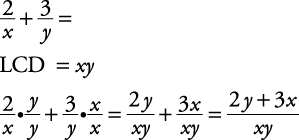
How To Add Fractions With One Variable In The Denominator. As you already know, we can simply put a 1 in the denominator of any number without changing its value: If the denominators are not the same, you must find the common denominator by finding the.
Operations With Algebraic Fractions from www.cliffsnotes.com
If the denominators are not the same, you must find the common denominator by finding the. To subtract fractions proceed as in addition but combine the numerators by subtracting. Then, divide the least common multiple by the denominator in.
If The Denominators Are Not The Same, You Must Find The Common Denominator By Finding The.
You need to create a class that is a wrapper for fractions. If required, we can simplify the resultant fractions into their lowest term. To change into an equivalent fraction with denominator a b c d, multiply c d by the factors it is missing, namely a b.
Simplify The Fraction (If Needed)
Add fractions using the following steps: 10 15 10 15 is not simplified because 5 is a common factor of 10 and 15. In order to add fractions, we first rewrite them with the same (or common) denominator.
If Necessary We Can Simplify The Fraction To Lowest Terms Or A Mixed Number.
A fraction is considered simplified if there are no common factors, other than 1, in its numerator and denominator. To add the fractions 3/5 + 4/3, we need to multiply both the fractions with a number which makes the denominators equal. As you already know, we can simply put a 1 in the denominator of any number without changing its value:
1 5 + 2 5 = 3 5 (The Denominator Will Always Stay The Same) Adding Fractions:
The first thing that we need to do in this case is to convert the 2 into a fraction. Make sure the bottom numbers (the denominators) are the same, step 2: That accounts for the last term in the numerator.
For Example, 2 3 2 3 Is Simplified Because There Are No Common Factors Of 2 And 3.
To add fractions there are three simple steps: Multiplication of proper fractions is simple, as we can directly multiply the numerator of one fraction with the other fraction and the denominator of one fraction with the other fraction. Simplify or reduce the answer.