How To Add Fractions With Different Denominators Algebra
How To Add Fractions With Different Denominators Algebra. (the denominators should now be the same.) Add the equivalent fractions that you wrote in step 2.
Simplify - Add Or Subtract Fractions With Step-By-Step Math Problem Solver from quickmath.com
For example, ½ + ⅗ lcm of 2 and 5 = 10 = (5/5) x (½) + (⅗) x (2/2) = (5+6)/10 = 11/10 Multiply the two terms on the bottom to get the same denominator. Find the least common denominator.
Dividing The Numerator And The Denominator By The Same Number To Get An Equivalent Fraction.
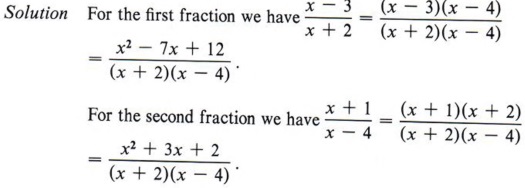
Adding fractions adapted from mathisfun.com there are 3 simple steps to add fractions: Steps how to add or subtract fractions with different denominators step 1: For fractions with different denominators that are going to be added or subtracted together, you calculate the common denominator in the normal way.
You Can Use This Method To Add Or Subtract Fractions:
Make sure the bottom numbers (the denominators) are the same. In other words, the numerator and denominator have no The symbols just represent numbers.
Rewrite The Fractions So They Share The Same Denominator.
Write equivalent fractions (making sure that each equivalent fraction contains the least common denominator (lcm)) 3. Add the top numbers (the numerators). Given two unlike fractions where the denominators are not the same.
Steps For Adding Fractions With Unlike Denominators.
To add fractions there are three simple steps: Add the top numbers (the numerators ), put that answer over the denominator. And now we can add, now we can add and it's fairly straightforward.
{Eq}\Rm \Dfrac {Ad} {Bd} + \Dfrac {Cb}.
Adding or subtracting algebraic fractions with different denominators might be little bit tricky. If the fractions have different denominators, first. Confirm the denominators of the fractions are different.