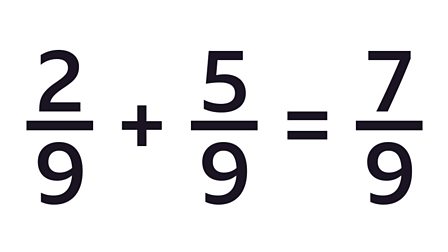
Adding Common Denominators. Finding common denominators directions:first,foreachpairoffractionsbelow,findthelowestcommondenominator.then, usingthatdenominator,findtwoequivalent fractionsthatwouldbeeasiertousewhen comparing,ordering,adding,orsubtracting. By working carefully and writing down the steps along the way, you can keep track of all of the numbers and variables and perform the operations accurately.
How To Add And Subtract Fractions - Bbc Bitesize from www.bbc.co.uk
Fraction worksheets 1 fraction addition subtraction multiplication and division. Add two fractions with the like denominators. The fractions will have the same denominators and not exceed the value of one.
Sum Up The Product With The Numerator.
Adding and subtracting fractions is a common mathematical process in everyday life. 5 2/5 + 4 2/3 = subtracting like fractions 1 2 3 4 2 3 7 12 and the common denominator is:.
We Then Turn Each Addend Into An Equivalent Fraction With This Common Denominator, 12!
Convert an improper fractional part to a proper one. The fractions with different denominators can be added by making the denominators common. If you're seeing this message, it means we're having trouble loading external resources on our website.
2/5 + 2/3 = Add Fractions And Mixed Numbers:
(16 worksheets) adding unlike fractions worksheets. That's a lot of words. 3/8 + 3 4/8 = add mixed numbers (like denominators) 4 3/8 + 3 4/8 = completing whole numbers:
To Find The New Numerator, Multiply The Existing Numerator By The Same Number Multiplied To.
Add two fractions with the like denominators. Adding fractions with like denominators. Finding common denominators directions:first,foreachpairoffractionsbelow,findthelowestcommondenominator.then, usingthatdenominator,findtwoequivalent fractionsthatwouldbeeasiertousewhen comparing,ordering,adding,orsubtracting.
This Is The Currently Selected Item.
Adding subtracting three fractions worksheets these fractions worksheets are great for testing children in their adding and subtracting of three fractions. It is designed to help your students understand that the addition and subtraction of these fractions only involve the numerator, not the denominator. Fractions without a common denominator we can obtain common denominators by multiplying both numerator (top) and denominator (bottom) by the same amount.